Online Pouch Sales are Safe
21st May 2026
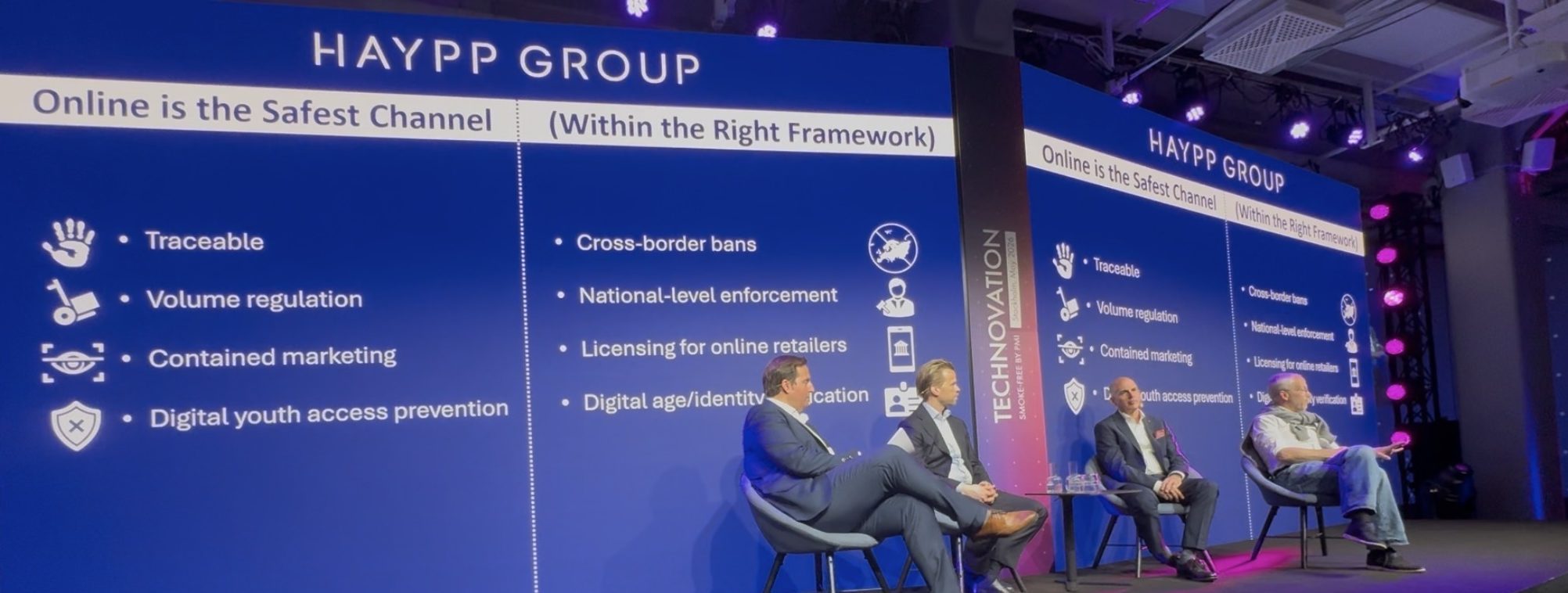
At this month’s Technovation in Stockholm, scientists, policymakers, and industry leaders gathered to discuss the future of smoke-free products, including nicotine pouches. Haypp’s Markus Lindblad explained why online retail is structurally better at preventing youth access to nicotine than physical stores, and what framework is needed to make it work across the EU.
Lindblad opened by clarifying how Haypp e-commerce platforms operate: “We are not social media. We operate online sales on an online store. Online is the safest channel within the right framework.”
That framework has four pillars:
- Cross-border bans on online nicotine sales so national rules can actually be enforced
- National-level enforcement rather than municipal patchworks
- Licensing for domestic online retailers, and
- Mandatory digital age and identity verification
With the EU’s Tobacco Products Directive under revision, TPD3 is a key opportunity to set clearer rules for all these issues.
On cross-border sales, he was direct: “If you have regulation in place, then it should also be possible for legal authorities to enforce the laws. And if you’re selling from somewhere else, it’s a hard time for authorities to travel over to other jurisdictions.”
Haypp also presented its approach to age verification. In physical stores, age checks are often manual and inconsistently applied. Online, by contrast, verification can be built into the transaction itself. With no harmonised EU standard, the company works with market-specific providers—selecting the strongest local partner in each country. The method varies by country, but the outcome is the same: every transaction is age-verified.
The message from Stockholm was clear. Responsible online retail is part of the solution. But only if regulators, manufacturers, and retailers work together to build the right framework around it.