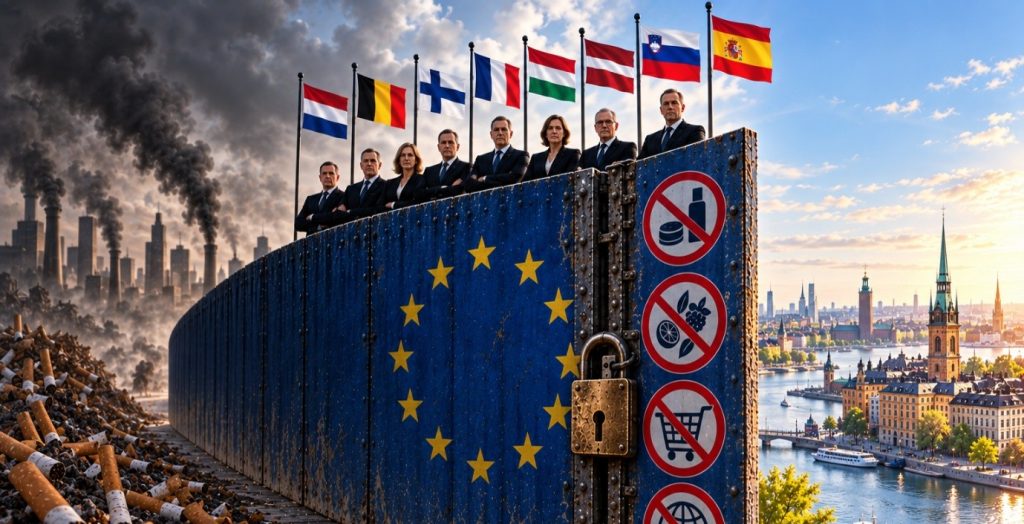
Poland’s Proposed Flavour Ban Risks Undermining EU Law and Smoking Cessation
08th May 2026

Poland has notified draft legislation that would ban flavours in nicotine pouches and prohibit all new nicotine products not covered by the EU Tobacco Products Directive (TPD). While presented as a public health measure, the proposal raises serious concerns. In practice, it risks undermining fundamental EU principles and discouraging smokers from switching to less harmful alternatives such as nicotine pouches.
At the core of EU law is the principle of free movement of goods between Member States. Measures that significantly restrict the sale or availability of lawful products are generally prohibited. Poland’s proposed flavour ban—combined with a sweeping ban on other nicotine products—would make it extremely difficult, if not impossible, to market these products. In effect, this amounts to a barrier to trade.
While Member States can impose restrictions on public health grounds, these measures must be necessary and proportionate. The Court of Justice of the European Union has consistently made clear that governments must adopt the least restrictive measures capable of achieving their objectives. In this case, Poland has not demonstrated why less restrictive alternatives would be insufficient—especially when the proposal itself risks reducing the transition away from cigarettes.
Poland already regulates nicotine pouches through age restrictions and sales requirements. The draft legislation does not explain why these measures would fail to protect public health. Introducing a flavour ban on top of existing rules is therefore not only unjustified, but also counterproductive and legally questionable.
The impact of a flavour ban would be far‑reaching. Approximately 99% of nicotine pouches are flavoured, and flavouring is also standard across most smoking cessation products. Flavours play a crucial role in enabling adult consumers to move away from cigarettes. Removing them would, in practice, eliminate the availability of these products—despite them remaining formally legal. This would reduce competition, limit consumer choice, and ultimately disadvantage smokers seeking less harmful alternatives.
Even more concerning is the proposal to introduce a blanket ban on all new nicotine products outside the TPD. This represents an exceptionally far‑reaching intervention, yet it lacks a clear and evidence‑based justification. Poland does not demonstrate that all such products pose significant health risks, nor does it explain why more proportionate regulatory measures—such as product standards, labelling requirements, or targeted sales restrictions—would not be sufficient.
The approach is also inconsistent. New tobacco products that are already regulated at the EU level would face less restrictive treatment than many non‑combustible alternatives. This risks creating an incoherent and unbalanced regulatory framework that discourages innovation in lower‑risk products.
Taken together, Poland’s proposal risks weakening both EU law and the integrity of the internal market. Protecting public health is essential—but it must be done through evidence‑based, proportionate regulation. Otherwise, there is a real risk of opening the door to fragmented national rules that erode the EU’s fundamental principles—while at the same time removing viable alternatives for smokers who want to switch.