TPD3: Europe’s Real Problem Is Smoking
04th Nov 2026

As Europe prepares to rewrite its tobacco rules, the EU has an opportunity to make a real difference to public health. But policymakers need to start in the right place. The goal cannot be to tackle all nicotine products with the same tools. The goal must be to reduce deadly smoking.
Europe is facing one of the most important crossroads in tobacco and nicotine policy in decades.
The European Commission is reviewing the Tobacco Products Directive and the Tobacco Advertising Directive. The EU’s overarching ambition is to achieve a “tobacco-free generation”, defined as reducing tobacco use to below five percent of the population by 2040. At the same time, the Commission’s own evaluation, published in April 2026, concludes that the current rules have contributed to declining smoking rates, while new tobacco and nicotine products present new regulatory challenges.
This means that TPD3 will have a major impact on how Europe approaches cigarettes, vapes, nicotine pouches and other nicotine products for many years to come.
The question, therefore, is not whether the EU should regulate. The question is what regulation should actually achieve. If the objective is to reduce the disease and premature death caused by smoking, every proposed measure must be assessed against that goal. Will the measure help more people stop smoking? Or does it risk making it harder for today’s smokers to quit?
“Europe has a historic opportunity to accelerate the decline in smoking. To do that, the regulatory framework needs to encourage adult smokers to choose less harmful alternatives, not make those alternatives harder to access,” says Markus Lindblad.
Not All Nicotine Products Are Cigarettes
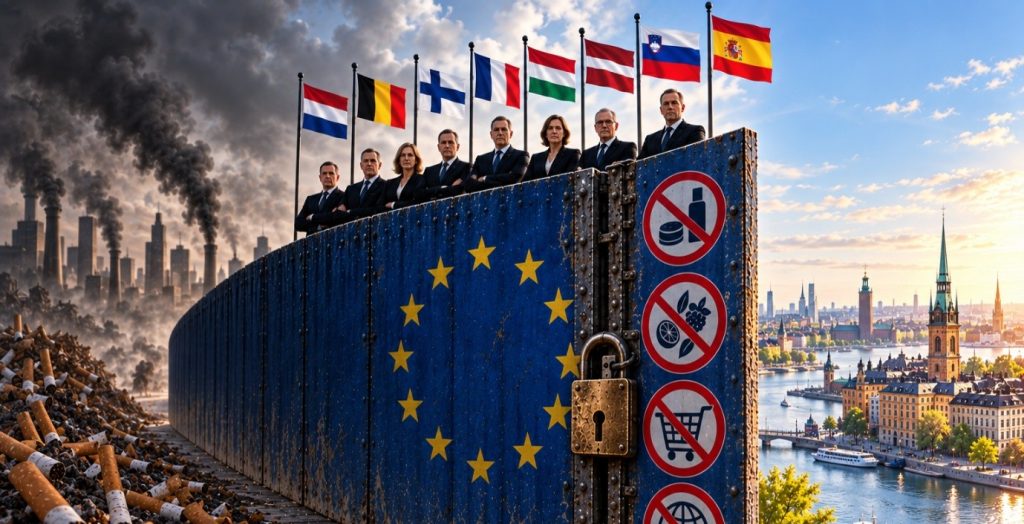
It sounds obvious. Yet much of the European debate appears to be heading in the opposite direction. The Netherlands, Belgium, Finland, France, Hungary, Latvia, Slovenia and Spain have jointly argued for a significantly tougher approach in the EU’s upcoming regulatory framework. Among the proposals are restrictions on new nicotine products entering the market, broad flavour bans, nicotine limits and the possibility for Member States to ban nicotine pouches altogether.
It is a policy that may sound decisive. But decisive does not necessarily mean effective. If less harmful alternatives become more expensive, harder to buy, less appealing or are banned altogether, one crucial question remains: What will smokers choose instead? The disappearance of a legal sale of a vape or nicotine pouch tells us nothing about whether that person has stopped using nicotine. More importantly, it tells us nothing about whether that person has actually stopped smoking.
This is precisely where the discussion around tobacco harm reduction needs to become much more grounded in real-world behaviour. A smoker does not have to become nicotine-free overnight to make a fundamental change to their health. The crucial first step is to eliminate combustion and cigarette smoke.
“When policymakers treat all nicotine products as if they were the same, they risk overlooking the most important public health question: How do we get more people to leave deadly cigarettes behind?”
The EU Should Look Further Afield Before Reaching for Bans
The eight Member States now advocating a highly restrictive approach therefore have good reason to look carefully at what has happened outside Europe before moving ahead. Not least in Australia. Australia has combined very high cigarette taxes with extensive restrictions on alternative nicotine products. The outcome presents a significantly more complicated picture than legal sales figures might initially suggest.
In June 2026, the Australian Bureau of Statistics (ABS) reported that household spending on legally purchased cigarettes and tobacco had almost halved since 2020. At first glance, that sounds like a huge public health success.
But the agency also noted that evidence from multiple sources suggests consumers have shifted from legal tobacco products to illicit sources, rather than the entire decline being explained by lower consumption. Experimental ABS estimates, based partly on wastewater data, also show that the amount of nicotine consumed increased by almost 40 percent between 2017 and 2025, while the population grew by 14 percent.
The Australian government has itself established a dedicated Illicit Tobacco and E-cigarette Commissioner, while the Australian Institute of Health and Welfare reports that people are increasingly obtaining nicotine products from illicit sources. That should, at the very least, give European policymakers pause for thought.
Falling legal sales do not automatically mean less smoking
If a smoker stops buying cigarettes because they have stopped smoking, that is a public health victory. If the same smoker disappears from sales statistics because they are now buying cigarettes illegally, very little has been achieved. After all, the lungs cannot tell the difference between a taxed cigarette and an untaxed one.
Australia Shows the Danger of Measuring the Wrong Things
This is also a central lesson from previous discussions around harm reduction: policymakers tend to measure what is easy to measure. Legal sales. The number of registered products. Tax revenues. How many people report using a particular product. But if the objective is public health, the relevant end point should be much clearer: How many people are still smoking cigarettes? How many people die each year from smoking-related diseases?
Australia is not an argument that regulation, taxation or age restrictions do not matter. Quite the opposite. It is an argument that policy must follow the entire chain of consequences. If regulation reduces the legal sales of a product, policymakers also need to know where that demand has gone.
Pouch Patrol has previously highlighted precisely this problem, including the rapid growth of the illicit market and the wider social problems that have followed.
“When regulation focuses on shutting out legal alternatives instead of addressing real consumer behaviour, the market does not disappear. It goes underground.”
TPD3 Needs to Ask the Most Important Question First
All of this brings us back to the choice facing Europe. The European Commission itself acknowledges that smoking prevalence is not falling fast enough for the EU to reach its 2040 objective. In connection with its proposal for the new Tobacco Taxation Directive, the Commission stated that smoking prevalence in the EU remains at around 24 percent. That is where TPD3 must start. Not with the question: How do we get rid of as many nicotine products as possible? But with: Which measures actually result in fewer people smoking? The consequences must then be measured.
- If flavour restrictions are introduced, does smoking decline?
- If nicotine limits are imposed, do more or fewer smokers switch away from cigarettes?
- If nicotine pouches are banned, do users stop using nicotine, start smoking or buy the products illegally?
- If taxes are increased, does consumption fall or does the market simply shift elsewhere?
These are the kinds of questions that any public health policy worthy of the name must be able to answer.
Regulate Most Where the Harm Is Greatest
Arguing for harm reduction does not mean advocating an unregulated nicotine market. It is a good thing that the market is regulated, including newer alternatives such as nicotine pouches. Products should meet clear quality standards. Children and young people must be protected. Age limits must be enforced. Marketing must be regulated. But regulation must also take into account the relative risks of different products and their potential to replace cigarettes for adult smokers. That is the difference between regulation that looks good on paper and regulation that actually reduces disease and premature death.
Markus Lindblad has previously described the difference between Australia and Sweden clearly:
“Australia has opted for a one-sided approach of ever-tighter restrictions that has essentially resulted in a sharp increase in illicit trade. Sweden, on the other hand, also has high taxes and clear regulation, but has allowed snus, nicotine pouches and vapes.”
That does not mean the EU should blindly “buy into” the Swedish model either. The EU should not buy into any supposed truths without testing them against reality.
As TPD3 is developed, every major measure should be assessed against the same concrete outcomes: smoking prevalence, switching from cigarettes to smoke-free alternatives, relapse to smoking, smoking-related disease and mortality, and the development of the illicit market. Because ultimately, outcomes are what matter.
If Europe is serious about tackling deadly smoking, policy must be designed to move people away from cigarettes. At the same time, banning or severely restricting their ability to choose regulated alternatives such as vapes and nicotine pouches risks making that task harder.
TPD3 has the potential to become a powerful and important tool for European public health. But only if the EU regulates according to the problem it actually wants to solve. And that problem is still smoking.