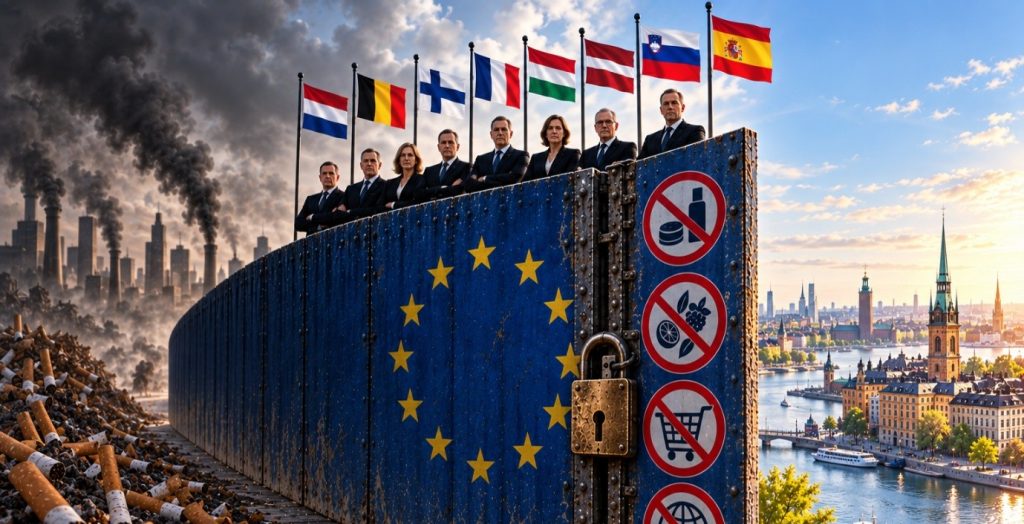
Is Europe Waking Up?
23rd Sep 2026

The Spanish government has taken an unexpected step in its ongoing regulation of nicotine pouches.
After more than a year of political debate and over 4,000 stakeholder submissions, the Spanish government has now raised its proposed nicotine cap from 0.99 mg to 4 mg per pouch. While the level remains low compared with products currently available on the market, the change represents a fourfold increase from the original proposal.
“The Spanish government’s decision to raise the proposed limit may signal something bigger than a simple Spanish policy adjustment. It could be the first sign that EU countries are finally beginning to listen to science, consumers, and reality.”
The revised proposal has now been submitted to Spain’s highest advisory body, the Council of State (Consejo de Estado), for review before it can become law.
The decision comes as the European Commission is preparing its revision of the Tobacco Products Directive (TPD3), the legislation that will shape nicotine product regulation across the EU for years to come. So far, many member states have pursued a highly restrictive approach, introducing bans, very low nicotine limits, or extensive flavour prohibitions. Against that backdrop, Spain’s adjustment stands out.
A Small Change with Potentially Significant Consequences
The Spanish government has retained several of the original restrictions included in the draft legislation. Non-tobacco flavours would still be prohibited, as would disposable vapes. At the same time, nicotine pouches would become subject to new marketing and sales restrictions. However, the increase in the nicotine limit remains significant.
“Had the original limit of just under 1 mg been adopted, most nicotine pouches currently used by adult consumers would effectively have disappeared from the market. A 4 mg cap is still restrictive, but it is also more aligned with market realities. It can be seen as the first clear signal that policymakers are beginning to move away from the most extreme regulatory proposals. It is a significant improvement compared with the original proposal, even if it is not the end goal,” says Markus Lindblad, Communications Director at Pouch Patrol.
“For years, we have seen European policymakers discuss nicotine pouches without paying much attention to how these products are actually used by adult consumers, or how nicotine pouches can help, and have helped, millions of people quit smoking. Spain’s decision to reconsider its own proposal suggests that arguments based on evidence and proportionality are beginning to gain traction.”
A Decision That Could Influence the Entire EU
Although the decision formally applies only to Spain, its impact could be much broader. Nicotine pouches currently fall outside the full scope of the EU Tobacco Products Directive, resulting in a patchwork of national regulations. Some countries have introduced outright bans, while others have adopted various nicotine caps or no specific pouch regulations at all.
As the EU prepares the next version of the TPD, national experiences from member states will play an important role. Spain’s decision could therefore signal growing resistance to the most extreme restrictive proposals.
“This issue is bigger than Spain. Europe is facing a choice. Either policymakers continue to treat all nicotine products as though they are the same, or they begin developing regulations that reflect the real differences in risk between deadly smoking and smoke-free alternatives. Proportionate regulation works better than symbolic bans.”
From Ideology to Evidence?
The debate around nicotine pouches has long been characterised by caution, but also by significant differences between countries. At the same time, Sweden’s experience demonstrates that widespread use of smoke-free nicotine products has coincided with Europe’s lowest smoking rates and the lowest levels of smoking-related disease. Europe’s nicotine policy needs to focus more on reducing smoking-related harm than on restricting all nicotine products in the same way.
It remains unclear whether Spain’s revised proposal will ultimately be adopted in its current form. But the change itself is already noteworthy.
“For the first time in a long while, we are seeing a European country move away from what was effectively a symbolic regulation and instead adjust its policy in a direction that at least partly reflects market realities. This is far from a victory for proportionate regulation. But it could be the first sign that Europe is starting to wake up.”