New Nordic Data Challenge the Gateway Hypothesis on Nicotine Products
12th Dec 2025

A new report from the Nordic Council contains compelling evidence that smokeless nicotine products—such as snus and nicotine pouches—are not a gateway to smoking. In fact, they appear to be helping drive smoking rates down across the region.
What is the Gateway Hypothesis?
The hypothesis originated in the 1970s–1980s in drug policy debates and was later applied to nicotine products. It proposes a sequence of initiation in which starting with one substance (e.g., vaping or nicotine pouches) “opens the gate” to smoking cigarettes, which is widely considered the most harmful way to use nicotine. This hypothesis is frequently cited as a reason to ban new nicotine-containing products.
What the NORMO 2025 Report Reveals
The Nordic Monitoring study (NORMO 2025) tracked health behaviours across Denmark, Finland, Iceland, Norway, and Sweden from 2014 to 2024. This large, representative survey used web-based questionnaires to collect data from 25,000 participants (≈5,000 per country). One section of the report focuses on “Smoking, Snuff, Nicotine Pouches, and E-Cigarettes.”
Among its findings:
Daily smoking rates have plummeted across the Nordic region—from 16% in 2014 to just 10% in 2024. The lowest rate is in Sweden, at 6.5%.
Use of smokeless nicotine products has risen, with 13.6% of adults now reporting daily use of snus or nicotine pouches. The highest rate is again in Sweden, at 20.4%.
Despite this shift, overall nicotine use remains stable, meaning these products are replacing cigarettes for adults who smoke.
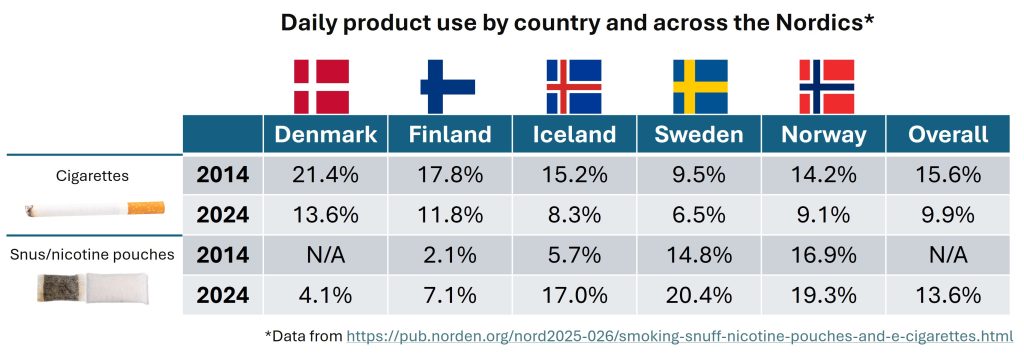
This trend is most striking in Sweden, which already boasts the lowest smoking rates in the EU. Of the five Nordic countries, it also has the most pragmatic regulatory approaches for oral smokeless nicotine products.
Crashing the Gateway Hypothesis
Critics have long warned that nicotine pouches could lure non-smokers into smoking. But the data tell a different story. If the gateway theory were true, rising pouch use should coincide with increased smoking. Instead, the opposite has happened: smoking rates have fallen dramatically while smokeless alternatives gained ground. In Sweden, the next generation is turning their nose up at cigarettes altogether. National Public Health Survey data from the Public Health Agency of Sweden show that just 2.3% of 16- to 29-year-olds in Sweden smoke daily (down from 7.9% in 2014). Similar patterns have been observed elsewhere, with e-cigarettes replacing smoking in England and heated tobacco doing the same in Japan.
Implications for Harm Reduction
Smokeless nicotine products can play a positive role in reducing tobacco-related harm. By offering alternatives to combustible cigarettes, these products help people move away from the deadliest form of nicotine consumption—smoking.
While this is great news, the NORMO 2025 report also highlights persistent social inequalities: smoking remains more common among those with lower education levels. Addressing these disparities will require targeted interventions and clear communication about the relative risks of different nicotine products.
“The gateway hypothesis looks more and more like a myth. Nordic data show that snus and nicotine pouches are not pulling people into smoking; they’re helping push cigarettes out of the picture.”, says Markus Lindblad, Head of Legal and External Affairs at Haypp.